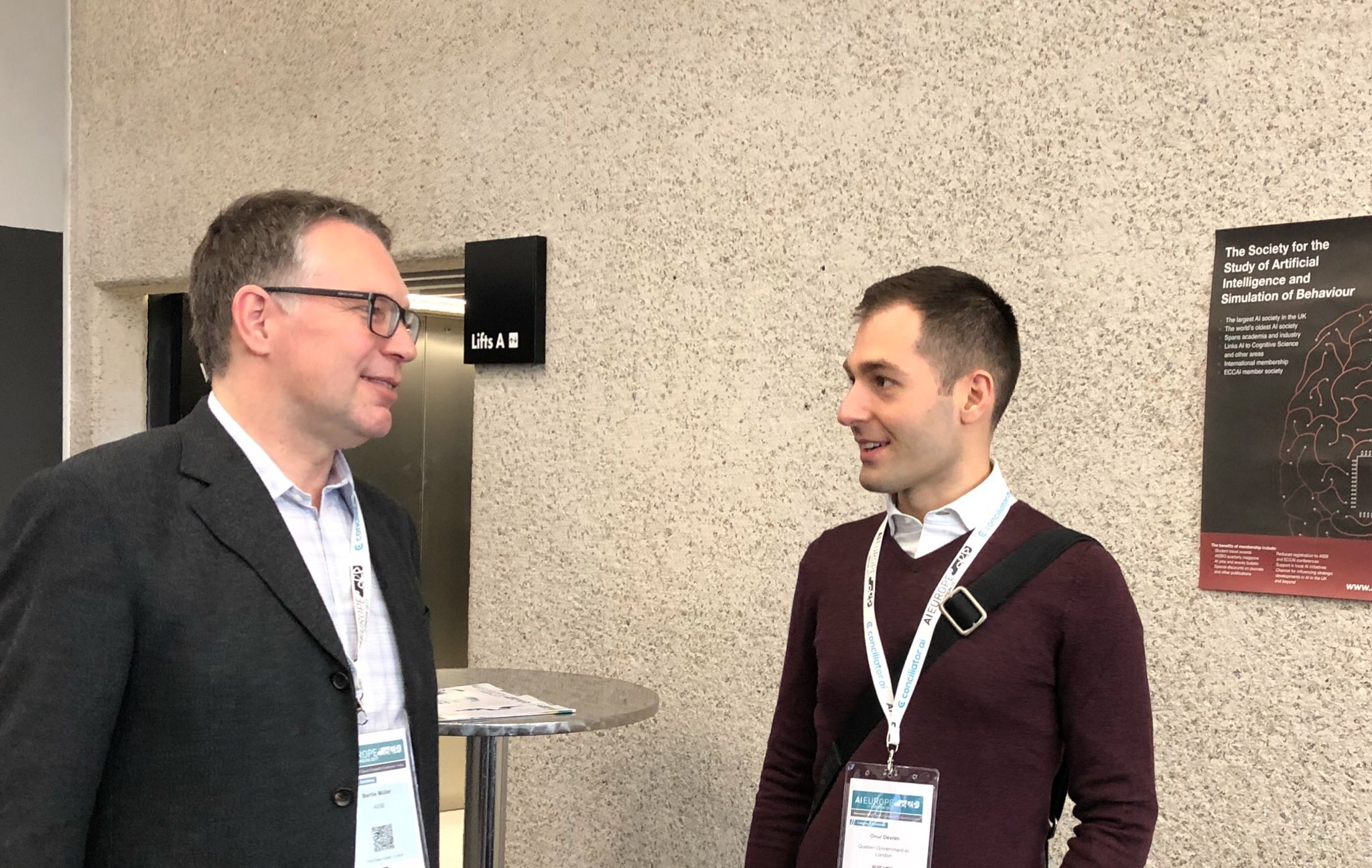
Engaging conversations and good feedback on my presentation on the need for responsible and ethical AI working for humanity at AI Europe on 20/21 November 2017.
Panelist at TFM 2017
On 27 September I will be one of the panelists at the Technology for Marketing conference held at the Olympia in London. We will be discussing the role of AI in marketing. Here are the details the panel:
Panellists:
- Jeremy Waite, Evangelist, IBM Watson
- Parry Malm, CEO, Phrasee
- Tom Smith, Senior Manager, Product Marketing EMEA, Salesforce
- Berndt Müller, Chair, AISB (Society for the Study of Artificial Intelligence and Simulation of Behaviour)
Moderated by:
Roland van Breukelen, Director Customer Engagement & Commerce, SAP Hybris
Loebner Prize 2015
On 19 September the 25th annual Loebner Prize in Artificial Intelligence was held at Bletchley Park. Dr Bertie Müller, Senior Lecture in Computing at the University of South Wales and Chairman of the Society for the Study of Artificial Intelligence and Simulation of Behaviour (AISB), organised this event with the help of further AISB-Committee members for the second time running. Bertie was interviewed by BBC News (broadcast live at 10:28 on 19 September) from Bletchley Park talking about the competition and how the Turing Test was relevant to us more than 60 years after its first publication. The interview and further BBC coverage was part of the week-long Intelligent Machines season across the BBC TV and radio channels. Throughout the day further coverage of the event was provided by the BBC News channel, Sky News, and CBS.
Some of the BBC coverage of the event is archived here and in related posts.
Furthermore, Bertie is quoted in the New Scientist article entitled “Forget the Turing test – there are better ways of judging AI” suggesting alternatives to the Turing Test as a measure of (machine) intelligence.
None of the chatbots managed to fool any of the judges. The prize for the most human-like machine went to Rose (developed by Bruce Wilcox).
Finalists
Steve Worswick
Brian Rigsby
Bruce Wilcox
Ken Hurturbise
Judges
Jacob Aaron – Physical sciences reporter for New Scientist
Rory Callan – Jones
Technology correspondent for the BBC
Brett Marty
– Film Director and Photographer
Ariadne Tampion – Independent Writer and Thinker
Confederates
Paul Beesley
– Software Engineer at ARM
Emily Jones
– Admissions registrar at Moorlands School, Leeds
Paul Sobek
– Software Engineer at Imagination Technologies
Chris Wignall –
Senior Software Developer at Lotus F1 Team
Programming
What has happened to the perception of programming being a science, an engineering discipline, or even art? Today’s students seem to think programming is nothing but copying code snippets from some dodgy sources, renaming variables (if they can even be bothered with that) and hoping that by magic this conglomeration of code odds and ends will produce the desired result. This approach is certainly not science or engineering. One might see an artistic spirit in it, but to me it mostly resembles guessing, gambling, and hoping that the parser will highlight & correct some syntax errors … and when the code compiles it surely has to be correct.
Collaboration anticipated with the HAW (University of Applied Sciences, Hamburg)
The Ambient Intelligence Laboratory at HAW, Germany has offered our research group access to their smart home lab to further our research and test the current version of our agent development framework in an existing life-like situation.The UbiComp-Lab in Hamburg was designed and built to study ubiquitous computing. We are planning to conduct a preliminary visit to ascertain the lab’s capabilities and interfaces so that our current work can be adapted to operate within the lab with a second, longer visit to conduct experiments using our software in the lab.

Connection Science Editorial
Connection Science, Vol. 27.1, now online: weblink
Read editorials from Tony Prescott and Bertie Müller
The Loebner Prize teams up with the AISB and Bletchley Park Museum
A warm welcome in the year of the AISB’s 50th anniversary
It has been an eventful year for the world’s oldest AI society. Interdisciplinary AI has been showcased as a thriving discipline at the hugely successful AISB-50 convention and in the no less successful AISB workshop series. But this is just the AISB’ s everyday business. Two behind-the-scenes events of the ongoing year are promising to have a longer-term effect on AI research and media coverage: A partnership between the AISB and the journal Connection Science published by Taylor and Francis has been arranged in October, and — following the official agreement with Hugh Loebner earlier this year — the decision that AISB would be taking permanent responsibility for running the annual Loebner Prize finals on the premises of Bletchley Park where Alan Turing worked as a code-breaker during World War 2.
We are thrilled that AISB has been chosen to host the longest-running Turing-Test competition started in 1991 and based on Alan Turing’s original conception of the test. Claims in the media that the Turing Test had been passed for the first time this year have left parts of the scientific community unconvinced due to various reasons. The Loebner Prize version of the test offers an established set of rules and even though still in its simpler first stage no submission has managed to pass this stage even 23 years after its inception. Once the it has been passed, the contest will enter a second stage introducing audio/visual components to the conversations. We are looking at some exciting years ahead.
On behalf of the AISB committee, I would like to thank the organisers of this year’s competition, Ed Keedwell and Nir Oren, and would also like to express my gratitude to everyone who has helped make this event possible, in particular Claire Urwin from Bletchley Park Museum, Paul Sant from the University of Bedfordshire, David Levy, and the judges and confederates who volunteered to dedicate their time to the event … and, of course, many thanks to Hugh Loebner without whose organisational and financial support all this would not be possible.
Bletchley Park, November 2014
Dr Berndt “Bertie” Müller (University of South Wales and AISB Chair)
The Loebner Prize Finals take place at Bletchley Park Museum on Saturday, 15 November 2014
dotdotdot …
 After the initial launch and its inclusion in the Futures Gallery at the Pierhead Building of the Welsh National Assembly, 1024by768.net will receive another online opening at dotdotdot v2 in London on 21 August: onedotzero
AISB Convention 2014 (AISB50)
The AISB is celebrating its 50th anniversary with an impressive array of symposia. The new web site gives all information and is updated with all the news around this special event. Stay tuned and come back for more details at: http://aisb50.org
CS&P 2013 in Warsaw
Straight after holding our 2nd-year degree students’ induction event, I will be travelling to Warsaw tomorrow to present a paper on a layered agent framework for smart home environments at Concurrency, Specification & Programming (CS&P 2013). The work presented is joint with my PhD student Jack Betts.